I’ve read about them. Square waves that is. I’ve sailed in 20 to 30 foot swell. Yes… those waves are mountainous, extremely energetic, but they are not square.. For the most part they are round if not rather chaotic… but mostly round.
When a powerful swell pattern like that first starts building, the waves appear and feel dangerous, but as they approach and the stern of the boat is lifted and they pass under the keel with all of their menacing hisses, rumbling and frothing… they continue on their merry way. That is downwind sailing in the trades. Sailing upwind and upswell in those conditions is an entirely different story… We tried that. Briefly. It was a feeble attempt to heave too so we could get some rest. A dismal failure it was. It was just too rough.
Running in the same direction with all that energy was the best ploy. And since we had 1000 miles to go in a general downwind direction we just kept on sailing downwind. Rinse repeat for two or three days. Then the wind started to ease, and the swell got back to a more manageable 6 to 10 feet. Square waves are different.
Les and I signed on as crew to help a friend get his Defever 53, Zebrina, a sister ship to ours, from Marina Del Rey up to the Northwest. There were a few mishaps during that passage, but for the most part it was an uneventful trip. With one notorious exception: Rounding Cape Mendicino. 15+ foot seas. 10-12 second interval between waves, and 50 knot winds. Heading into and over them was our only real option. Throttle up both engines to get up and over the approaching wave. Throttle back so the bow doesn’t plunge into the next wave. Rinse repeat for… about 6 hours. It was lively, but not dangerous. These were also not square waves…
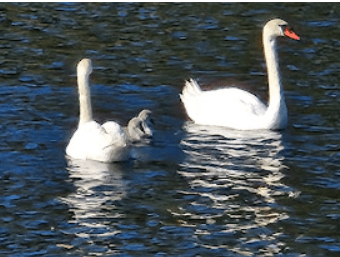
After Prevost Harbor covered in my last post, we checked into Canada at the Van Isle Customs station and then made our way to and anchored in Madrona Bay close to Ganges, Salt Spring Island. Where we were visited by a family of Trumpeter Swans:
We shopped for ships stores in Ganges and attended the world famous Saturday Farmers Market. It was… just about the same as the World Famous Port Townsend Saturday Farmers Market, and similar to most others for that matter. After a few days at Madrona, we moved on to the Dogfish Bay Anchorage (AKA Kendrick Island) Our goal was to cross the Georgia Strait and make our way to Gibsons in Howe Sound. and then to travel up the Eastern coast of the Strait of Georgia to Desolation Sound.
The morning weather of June 15th (wind and swell in the Strait of Georgia) was perfect for a passage. Light winds and flat seas were the beckoning signals.
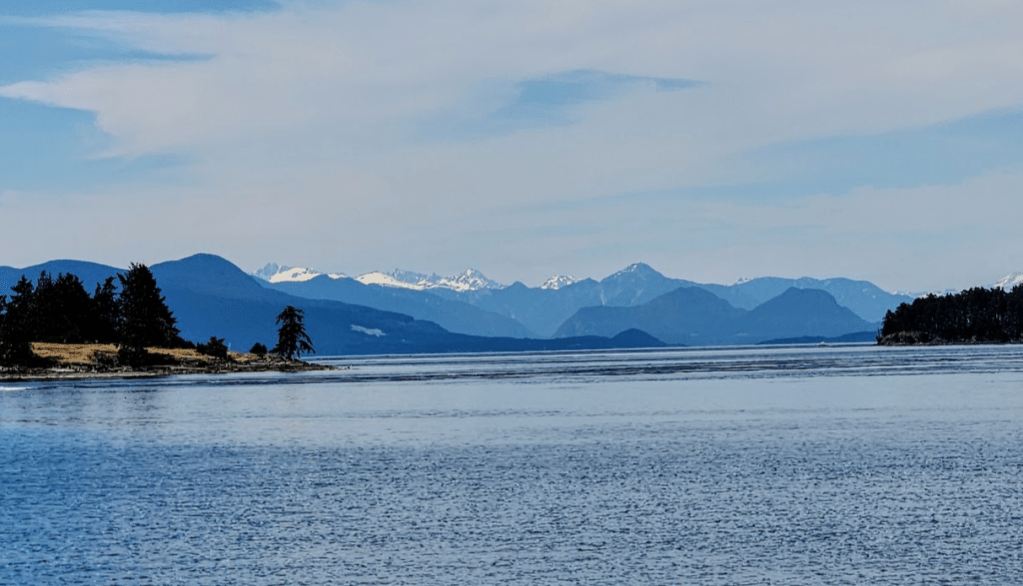
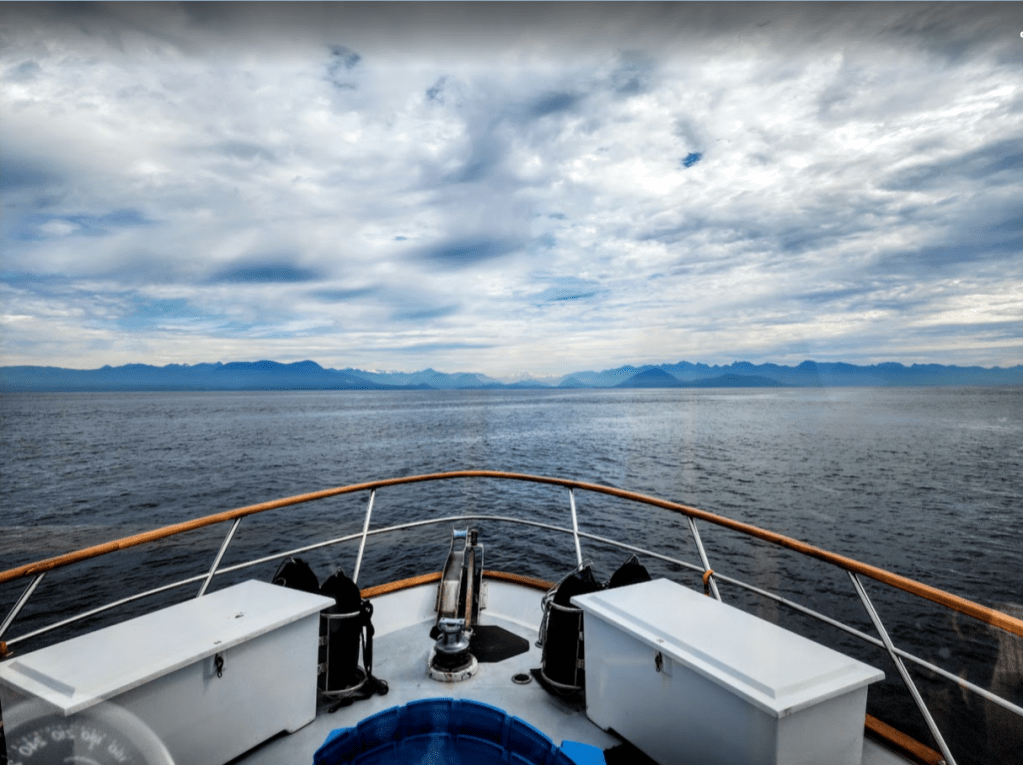
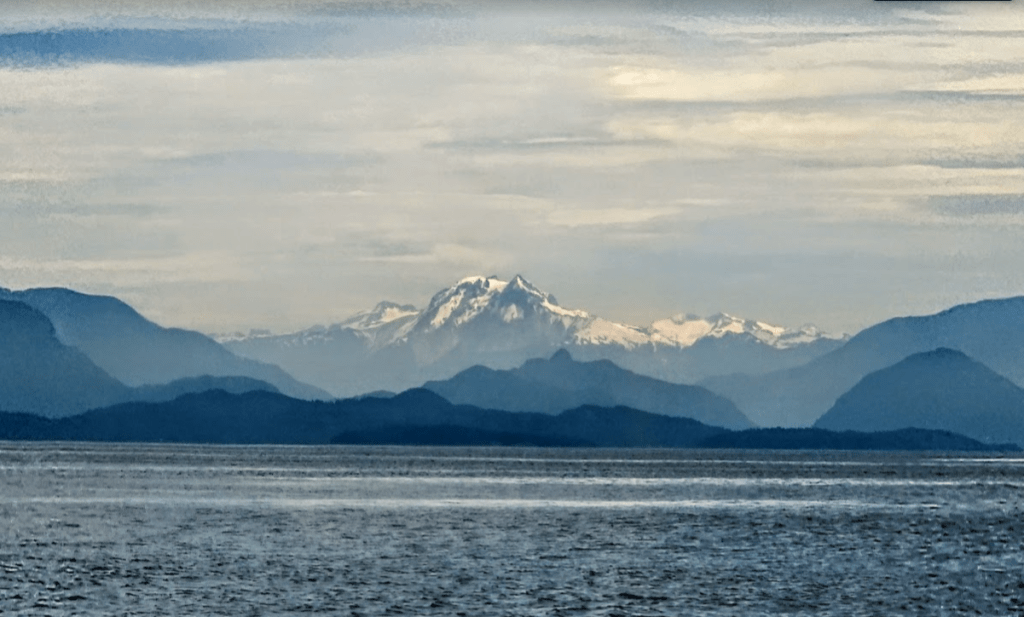
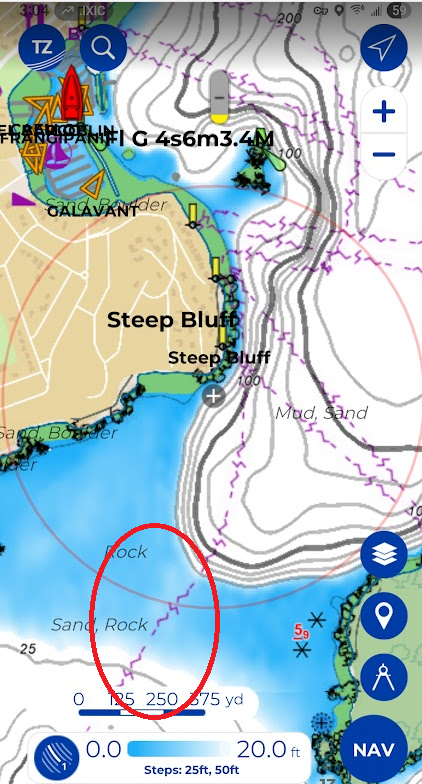
The route to Gibsons would take us across a shallow bar:
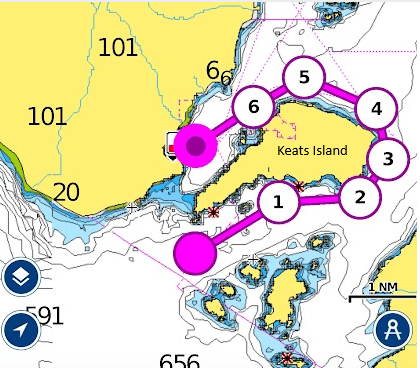
Since it would be a minus tide when we needed to cross the shallows, we decided to take the longer route around Keats Island to avoid any issues. That added 7 miles of sightseeing to our voyage.
We spent several days at the Gibsons Marina exploring Gibsons and taking the dogs on long hikes and visited the local restaurants and the Gibsons museum. June 18th looked good for a departure. Our goal was to depart Gibsons and make our way up to Secret Cove or Pender Harbor: Steppingstones to reach Desolation Sound. It was not to be…
The weather looked fine on paper. It had been windy and there had been significant swell running from the Northwest, but overnight everything had quieted down. According to weather reports, at 0800 the wind was at 5 knots and the swell was less than 2 feet. Time to go. Our depart winding our way out of the marina went just fine. We made our way to the shoal area and started through. We did see some whitecaps up ahead but all looked just fine. Great Northern is an ocean going, capable craft after all.
Well… about a third of the way into the shoal area we experienced something we’ve never seen: Square waves marching through the shoal and heading right for us. We slowed to 5 knots to lessen the impact, but it was not enough. The waves were 3 to 4 feet mixed in with the occasional 6 footer. The problem was… that the waves were very steep and very close together…. essentially square walls of water, one right after the other. The first wave lifted our bow as if we were a 70,000 pound cork, and as we topped it and came down on the other side we buried the bow in the next wave. Our bow and anchor are 8 feet above the waterline. It didn’t matter. After burying the bow we went up and over the next wave and buried the bow again. This time there was the sound of chaos erupting from the gally and salon. Breaking glass was part of the cacophony. Les leapt up and scurried back to the gally to find the refrigerator door wide open flinging itself violently back and forth and dumping all of its contents on the floor. Pickle jars and other broken glass items, tupperware containers of left overs etc. were churning around on the gally floor. Cabinet doors were opening and slamming shut. She stayed back there tring to manage the chaos and keeping the dogs away from the glass.
Meanwhile… I was standing behind the wheel negotiating our way through more square waves and more green water over the bow. Looking forward I could see that we had another 800 to 1000 feet to go to get through the shoal, but I could see very rough water outside the shallow area. So much for the Predictwind and local weather advisories. Time to bail.
To exit the shoal safely I had to go out another 300 feet to get around a small rocky islet that was frothing with spray and chop. As I started to veer away from banging directly into the waves the motion eased slightly because the stabilizers now had something to work with. The pitching motion lessoned (slightly) and we stopped taking green water over the bow, and the stabilizers attenuated some of the rolling motion. It was still a rough and wild ride. I waited for a break in the waves pattern, found one, gunned the engines to help the rudders make a quick turn towards Keets Island. Mission accomplished. The new course was mostly downswell and the wild, bucking Bronc motion eased somewhat. Within 300 feet we were out of the shallows and the worst of the motion.
Compared to the offshore 25 to 30 foot swell, and the swell and wind we experienced rounding Cape Mendocino… our experience with the square waves was far worse. Were we in danger of sinking? No. But we were in danger of breaking something. Was it scary? DAMN RIGHT!!
Cleanup on aisle 10…
After looking for a reasonable anchorage within Howe Sound and not finding one that felt safe enough, we ended back at the Gibsons Marina and stayed there for 4 days waiting for a weather window to open. What we finally saw was a period of time with light wind and low swell. We left the marina, and made our way back to the shoal area. This time there was no chop. The square waves were gone. It was high tide so we had 18 feet under the keel as we passed through it into open water. Three hours later we were back to Vancouver Island and made our way through Gabriola Pass and down to Montague Harbor and put down the anchor. Twas a lovely spot, but a Northeasterly wind was blowing right down Trincomali Channel into the Harbor. I didn’t feel comfortable with that so we raised up the anchor and made our way over to North Pender Island and the Port Browning anchorage. We anchored away from other boats and put out 200 feet of chain in 35 feet of water, a 6 to 1 ratio. We were not going anywhere.
What did we learn about the issue with the square waves? Failure mode number one: I checked the weather. Les checked the weather. We do that independently and then discuss what we think the weather will be like. That works better for us than just having one of us check the weather. It wasn’t windy when we departed Gibsons, but it had been windy the night before so… there was residual wave action present. We should have considered that important detail. Failure mode number 2: When we approached the shallows I did see rough water up ahead in the form of whitecaps. I failed to assess how powerful they were. I should have turned around at that point and didn’t. Failure mode number 3: When the first wave hit us I should have understood that we needed to reverse our course immediately and didn’t. Failure mode number 4: We did not rig the boat for heavy weather. We’ve become complacent about that and will pay much more attention to that aspect of cruising in the Northwest where it can get rough at times.
Beyond those thoughts… We stayed at Gibsons after our “event” and waited for a weather window to depart. We enjoyed the town and watched the weather closely. It looked like a Saturday morning, June 20th departure would work. But on Thursday we noted that the wind was still blowing strongly from the NW and the swell was still at around 4 feet, and probably bigger across the shoal. Friday came along and there was still a significant NW wind blowing so we decided to wait until Sunday morning for a departure if Saturday was quiet. Saturday was quiet. On Sunday, light winds were present and the swell was down to less than one foot. We departed Gibsons AT 1200 so we would be able to transit the shoal at high tide, and make Gabriola Passage on Vancouver Island at 1500, a good time to transit the rapids there. The shoal area was flat. The tide was full so we had 18 feet of water under the keel, and the passage through the shallow went without a hitch. Out in the Strait the wind was calm and the seas were flat.
I guess 2 old dogs can learn, eh?

 Salish Sea Cruising With Blair, Les, Leo, and Bliss