Day 3: An ambling stroll in the deep woods. Alone. Walking staff in hand. I had just picked it up. It was merely resting along the side of the scruffy trail, bidding me to become part of my journey, support system, and perhaps, if called upon, transmogrify into a defensive system. Did I feel I needed armament? Oh, I don’t know, but it made me feel… better somehow. More qualified to be there alone. More prepared. Oh yes… there are wolves lurking about. Watching. It is their territory. And… they have a desire and curiosity to discern who is encroaching on their turf. But, in general, they don’t mess with sapiens. They’ve been taught to trot away from encounters with the wild apes that have harassed or killed so many of them. There are resident black bears prowling about as well and an occasional black bear makes it to Cortes Island after swimming there from one of the other islands. (follow link for more information: https://cortescurrents.ca/coexisting-with-bears-on-cortes-island/ There apparently are cougars as well. Did my presence out there, alone in the woods, put me on the predatory list of things to dine upon? Very unlikely. If I were to leave the trail and sit in a little glade eating a ham sandwich and not pay any attention to my surroundings… Maybe. So why am I walking out in what’s left of the deep woods? Alone? Because I can. Nothing more. Nothing less.
Another 10 meters along the trail and I hear it. It was not the stealthy brushing of fur against the salal, or the crack of a small stick being stepped upon by a careless pup. But… a chittering off to my left. 15 meters and slightly up. Very likely: a squirrel. An alarmist proclaiming to anyone who cares to listen, that a territorial interloper is lurking about. 10 meters later along the trail, I hear a madcap highly caffeinated chirruping. 4 meters to my right and up 3 meters. Aha! A red squirrel. Quivering with rage. Tail quaking. Barking at me as if I were Polyphemus , the one-eyed cyclops giant, son of Poseidon, the god of the sea, who just crawled out of the depths of the Von Donup Lagoon, kelp tangled in its scraggly beard, in search of squirrel lunch meat. Quite the performance of unabashed valor it was. I stopped and talked to it in quiet and calming tones. Letting it know how valiant, brave and squirrel hearted it was. That didn’t stop it’s chattering and quaking one little bit. With my soliloquy finished, I turned around and made my way back to the trail head, hopped on my paddle board and went back to Great Northern to tell Les and the dogs my story and perhaps… a nap.

An interesting characteristic of Squirrel Cove: There don’t seem to be any squirrels. Due to human habitation, intense logging, and demolition of the undisturbed ancient forest, the cove habitat no longer supports a large (or any) red squirrel population. Encountering red squirrels in the more intact woodlands surrounding Von Donop was in some way uplifting to me. Even if the ones I encountered were… pushy little autocrats.
About the wolves. A couple of years ago we were anchored in Squirrel Cove. Squirrel is very close to Von Donup inlet where I am writing this tome. The red dotted lines tell that story:
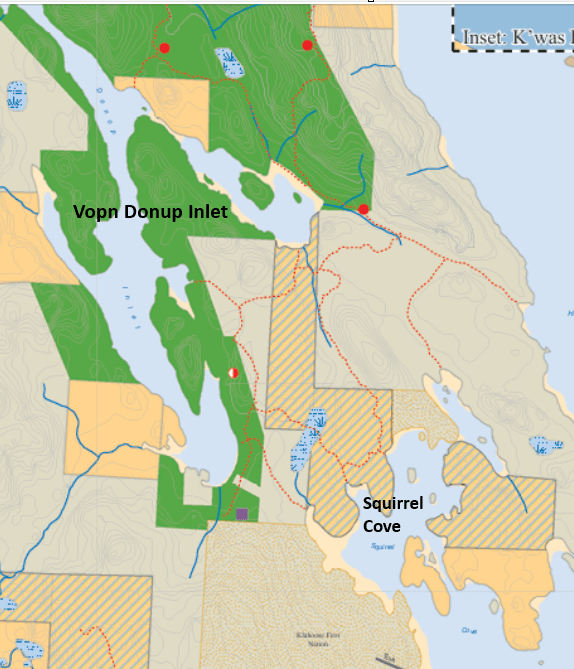
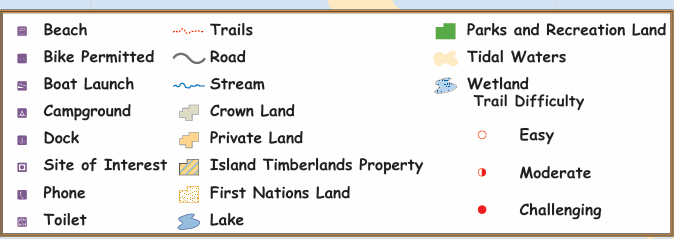
Most of the cruising guides mention the trails between Squirrel and Von Donup that are well maintained and in the 1.5 to 3 kilometer range. So… I thought that I’d take one of them. I paddled my SUP over to one of the trailheads, parked my board above the high tide line and started hiking. After about 600 meters I noted a particularly large scat lying bold as brass, right in the middle of the sparsely maintained trail I was on. It was fairly fresh and had bits of fur encased in it. Wolf scat. Having no bear spray with me, I turned around and went back to Squirrel Cove. I wasn’t particularly worried about being served up as lunch for the pups, but…
I’d read about there being wolves on the Island. Biologists have currently identified 7 adults and 10 or more youngsters that claim the island as their territory. There is a lot of chatter online about the wolves and the Islanders have engaged biologists and others to help create and propagate safe interactions between people, livestock, dogs etc. and the wolves. Consequence of not keeping wolves wild: A human habituated wolf becomes a dead wolf… I thought I’d provide their guidelines here for you to peruse. If that doesn’t interest just scroll past them. But there is one tenet that should ALWAYS be followed: Dogs must be leashed when walked in the forest. Unleashed dogs are seen as prey. I’ll explain further after the “guidelines” section.
Cortes Island Wolf Guidelines for Coexistence
Cortes Island’s coastal wolves are genetically distinct “sea wolves” with up to 75% of their diet from marine prey like clams, seal placenta, and pups cortesisland.com Tideline. To protect them and reduce conflict, the Cortes Community Wolf Project and Friends of Cortes Island promote a five‑point primer for residents and visitor
1. Never feed wolves
- Do not leave meat, seafood scraps, or compost near homes.
- Avoid feeding deer or raccoons, as they are wolf prey and can attract wolves to your area www.friendsofcortes.org.
2. Keep yourself safe
- In residential areas, use HAZE tactics: wave arms, shout loudly, use noisemakers, and adopt an aggressive stance to signal you will not tolerate their presence
- Carry an airhorn or bear spray when hiking alone or in wolf‑frequented areas at night
3. Keep pets safe
- Dogs must be leashed when walked; unleashed dogs are seen as prey
- Secure pets overnight in sturdy, predator‑proof kennels or inside your home.
- Keep pet feeding areas clean and never leave uneaten food out.
- Do not take dogs into natural areas like Carrington Bay, Von Donop Inlet, Hank’s Beach, or Marina Island
4. Practice good animal husbandry
- Fence livestock securely (min. 6′ high) by day and provide predator‑proof shelters at night.
- If wolves approach livestock during the day, HAZE them away.
- Dispose of carcasses deeply buried, away from residential areas
5. Avoid interaction
- Do not approach, photograph, or admire wolves up close.
- If a wolf “escorts” you or your dog, leave the area immediately.
- The goal is to keep wolves wild and wary—habituation can put them at risk
Reporting
- Report routine sightings to the Friends of Cortes Island office at 250‑935‑0087.
- Report concerning encounters to the Coast Guard at 1‑877‑952‑RAPP (7277)
By consistently following these guidelines, the Cortes community aims to maintain healthy predator‑prey relationships and ensure wolves remain a wild, respected part of the island’s ecosystem (end of guidelines)
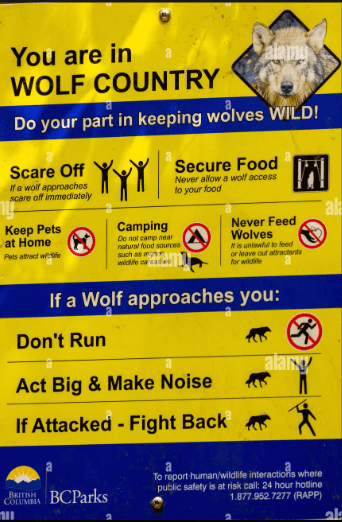
These signs are more common now at trailheads on the island than the last time I was here:
Seven days ago when we first anchored in Von Donup there were 3 other boats in our location at the end of the Inlet. It’s been delightful. There are now more than 20 boats within our little world. Still plenty of room, and everyone has been quite respectful in terms of noise, creating wakes etc… with the exception of 3 assholes who bombed through the anchorage yesterday evening on jet skis at full speed.
Boats do come and go. Most just stay for a day or two on their way to other cruising destinaitions. In general at least least half of them have dogs. Dogs that need to go to the beach… several times a day. Rain or shine. Big dogs, little dogs, all in boats, looking forward to a quick romp and a quicker extrusion:
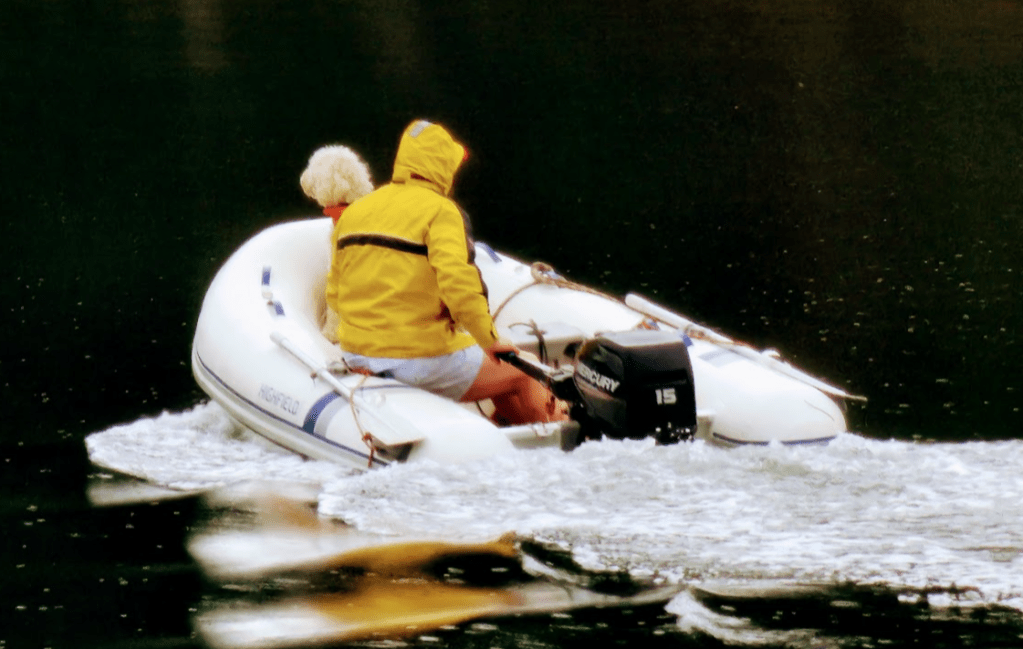
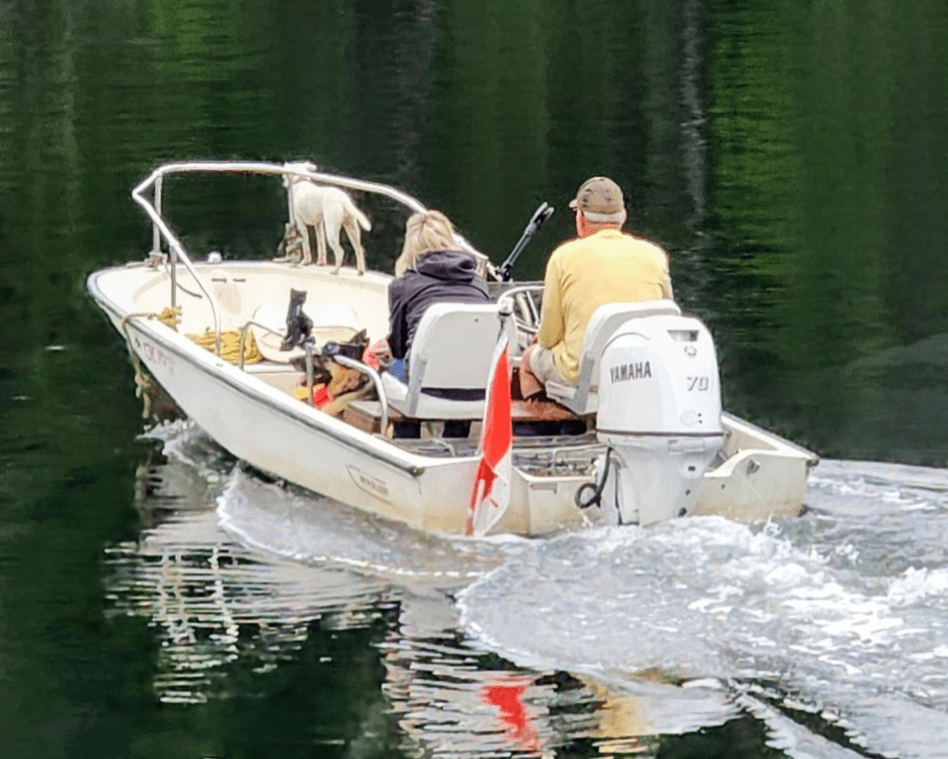
Point being… absolutely none of them are on leashes. Remember the biologist created guideline above: Dogs must be leashed when walked; unleashed dogs are seen as prey. Well the dogs hop off of their respective boats and run onto the beaches and go directly into the woods to do their business. It makes one wonder how many of them never come out of the woods… I bet that tourist behavior just drives the islanders batty…
Being the guardian of two small fluff balls this topic is of interest to me. First off… they have a box on the boat we line with a pee pad. They do most of their “business” there. Sometimes their target is a bit off. A small price to pay for the joy they bring to us. So going to the beaches of predatory filled woodlands becomes a nice to have field trip for them… but is not compulsory to place them in the sight lines of those who want them for lunch.
I did an internet search looking for reports of dogs that have gone missing around Squirrel and Von Donop. Apparently, dogs do go missing and are never found, and there are reports of resident dogs being killed by the coastal wolves living on the island. Biologists have done dna testing on wolf scat to determine what they are eating. I imagine if they evaluated enough piles of wolf scat they would find some dog dna amongst the deer, river otter, racoon and red squirrel dna…


One thought on “Von Donup Inlet… An Extraordinary Setting Amidst Idyllic Locales”