Ah… the modern convenience of a late model car with a proximity key. Gas guzzling, hybrid, or full electric… if you stuff the proximity key in your pocket, you are in instant, real time communication with the beast any time you are near it. If you approach it after the sun goes down, it responds by turning on a nice little light to let you know where the door handle is. You open the door to its domain and slither into its comfortable and inviting cabin. No key needed, and the rest is so easy.
Press your foot on the brake pedal, and push an ergonomically located button. The engine starts or the car wakes up depending on gas, hybrid, or full electric. Simple. Intuitive. Secure.
And… it will take you anywhere that roads lead. Soon enough, just telling it verbally where you desire to go, in any language, it will take you there. No muss. No fuss. Just feed it fuel or plug it in. Done.
Contrast that with a 1986 DeFever motor yacht like ours. It is of course no get away car with seating for four or five and a small trunk that gains you access to millions of miles of paved and unpaved roads. A vessel like ours has ample fuel, 400 gallons of fresh water, two large engines, two generators and a large twelve volt battery bank, hydraulic stabilization, storage for months of dry goods, plentiful refrigeration and a chefs stove in the galley. Good thing I like to cook…
Great Northern is an imaginative and creative design by Art DeFever, a noted naval architect. The parameters for its design included being able to safely negotiate relatively rough seas. What does that mean? Well… we helped deliver a sister ship from Marina Del Ray up to the Pacific Northwest about five years ago. We encountered a few rough spots during that passage. One was off the coast of Oregon as we transited across the outflow of the Columbia River. A notorious spot. The other was 20 miles off the coast of California while rounding Cape Mendocino. The seas were short period 15 to 20 feet and a bit chaotic. Hand steering was warranted. The winds were a steady 40 to 45 knots gusting to 50 and 60 knots with no where to hide. Yes it was uncomfortable, but it never felt unsafe… Off shift sleeping was interesting.
The other major design parameters included being able to get and stay away from most things like fresh water from a tap, fuel, groceries, emergency services, mechanics, and crowds. As cruising boaters, those considerations serve us well.
Australians call the places we like to cruise the “Whoop Whoops” which are located just the other side of the middle of nowhere. Places with no roads. Unless you considers waterways, bays, inlets, sounds, straits and open ocean nothing more than watery roads as we do…
It is quite the process waking up Great Northern, hoisting the anchor and cruising away into the “sunset”. There are multiple steps to follow and they occur at various locations throughout the vessel. There is no proximity key. On our boat, keys are not involved at all. If you don’t know where the light switches are… a flashlight or headlamp does come in handy.
The primal step: open the engine room door. Then: Check the oil on each engine and transmission. Top off if necessary.
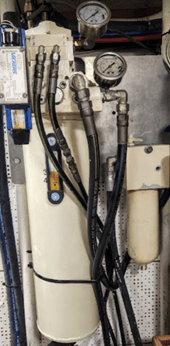
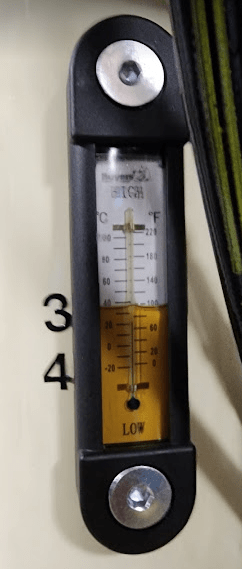
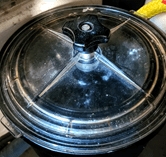
Check the oil level in the NAIAD stabilizer oil tank. The heart of the stabilizer mechanism with the oil level can be seen with a quick glance. It seldom needs topping off, but it is good to know that none has leaked out (which has happened, of course) The oil level gauge is at an appropriate level:
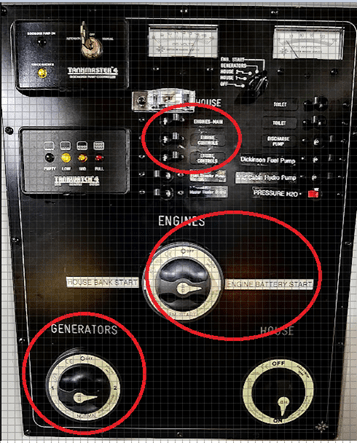
Locate the electrical panel attached to the aft bulkhead. Rotate the “GENERATORS” switch to “2” for the small 9KW generator (Genny), or to “1” for the big boy beefy burger, 23KW generator (Hagrid). Either will work, but the Genny is ample for most of our needs.
Rotate the “ENGINES” switch to “ENGINE BATTERY START”. Flip the “ENGINES MAIN”, and both “ENGINE CONTROLS” switches to the right That turns on the Glendenning electric engine controls.
Locate the On / Off switch on the 9Kw generator on the Port side of the engine room. Press and hold the “START” button. The fuel pump will click for a bit and you will hear diesel fuel dripping into the large Port side diesel tank, and as soon as the glow plugs are hot enough to start the engine… it will start. Note the time in the log that the generator was started for future reference.
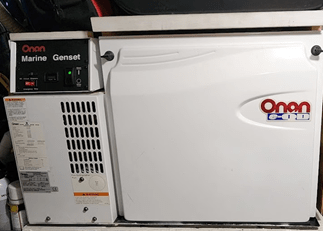
To the left of the generator is a little device that lets you see if seawater is flowing into the generator: vigorous bubbling demonstrates that the water pump is moving saltwater into the heat exchanger as it should. If it doesn’t… well there are ways to get it to work. That can happen if the gen set has not been used for a while.
Your work is done in the engine room. You may leave and make your way up to the pilothouse. Leave the lights on… That will help when you do your hourly engine checks. Digital and analog gauges are no substitute for a hands on / eyes on review of engine room systems while cruising about.
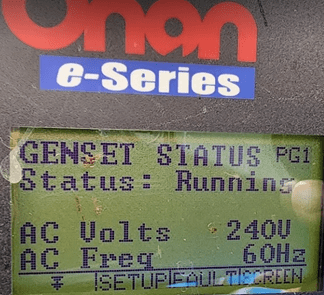
Once up in the pilothouse, check the generator’s output which should state a Status of Running. AC volts of 240. Good to go on the gen set.
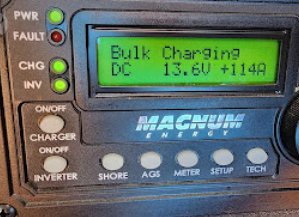
Check the Magnum Inverter control. It should display an appropriate charge status, current voltage and amp draw on the battery bank.
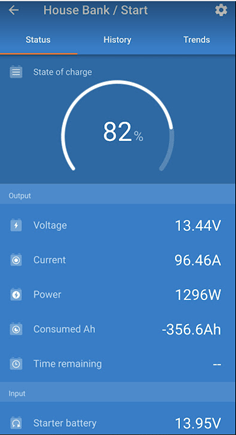
Now is a good time to check the Victron charging systems to make sure all is copacetic:
Now. More switch rotating and switch flipping is necessary to move forward. If you have been on Shore Power (1 is 50 amp, 2 is 30 amp, you may leave the inverter settings on bypass. If you’ve been on inverter, flip the INVERTER IN and BYPASS switches to the left. That will automatically switch the INVERTER OUT switch to the right:
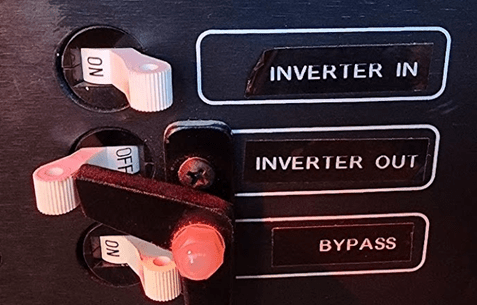
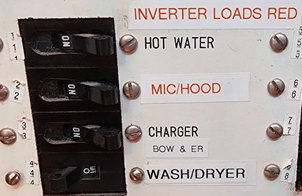
Turn off the switches pictured below: This will prevent a power surge on the gen set when you switch the gen set power on.
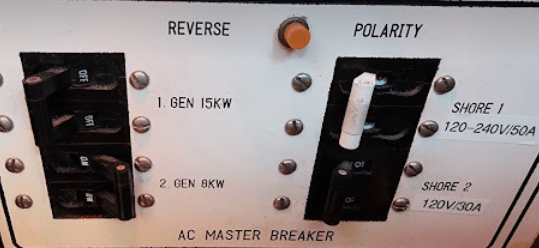
Switch the SHORE1 OR SHORE 2 off and switch the 2. GEN 8KW to ON (Yes I know. Gen 2 is now a 9KW generator, the panel is old and the old Gen 2 was an 8KW set):
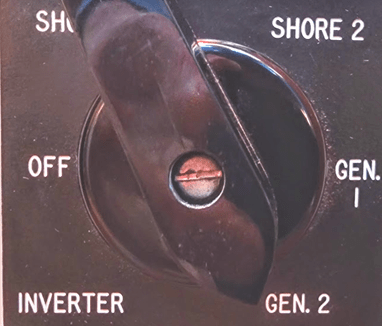
Rotate the power selector switch to GEN 2
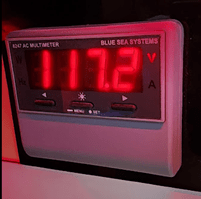
Check the electrical panel volt meter to see if the generator is generating an appropriate voltage
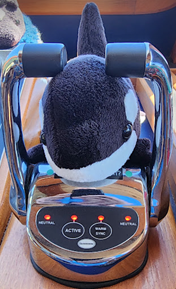
Check the electronic throttles to determine if they are on. All 4 LEDs should be on. Orkie is watching closely. Meta is also providing backup, so take care.
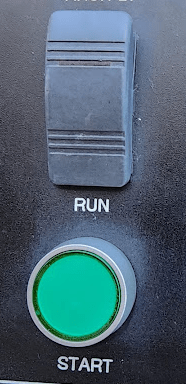
Push down on the upper part of the RUN switches for both engines. Then press the green start button for each engine. I always start with the port engine (Fred), then follow with the starboard engine (George). Yes they have names. Both will dutifully roar to life. You can’t miss their deep, satisfying rumble… Note that the Engine Hour meters have little hour glasses that start to blink. Record the time displayed on each meter in the log for future reference.
Calmly walk to the stern of the boat to determine if water is coming out of the exhaust outlets on the transom. You cannot see them, but you can see the water moving behind the boat. You are there. Done… Mostly… and ready to start motating. Sort of… There is a lot to learn before attempting to drive a boat like Great Northern.
I did not present the final tricks of how the electronic engine controls work. That information is above and beyond getting the engines started and ready for action. But… it is similar to the effort taken to move a cars shifter to D (Drive). I also did not cover the steps that need to be taken to turn on the electronic navigation equipment, radar, activation of the autopilot, plotting a course and other notables. If you are interested in going over any of those processes… just let me know.
So as you can see… a boat like ours is not quite like walking up to a car, opening the door, sitting down and pushing a button. But… if it were that simple, anyone could do it. If you are in the neophyte phase of boating, I recommend starting with a simpler design, and do hire a captain to teach you how to safely run a boat of any size.
Just imagine how many steps it must take to get a large container ship up and running. How about a fighter jet, or a locomotive, or a rocket ship taking astronauts to the moon. Hmmm… Lotta sequential steps involved, eh?
As I finish writing this we are anchored just off a rocky reef in Blind Bay, Shaw Island in the San Juans:
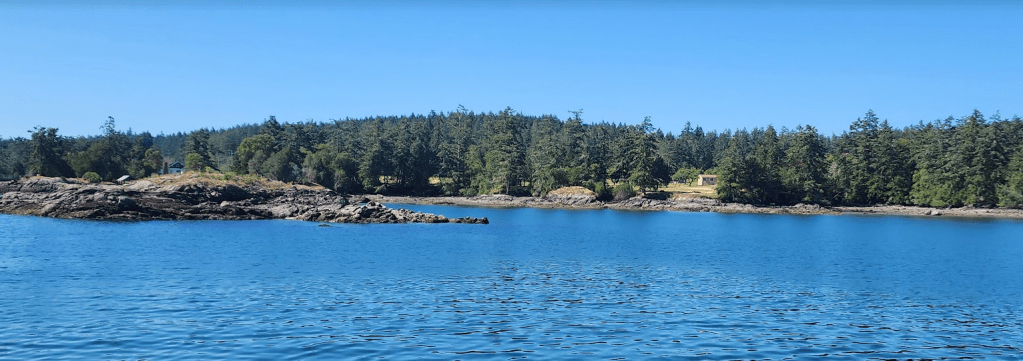
Tomorrow we will hoist the anchor, raise the colors and make our way further into the Whoop Whoops.
Hope you found this interesting… Place a comment if you’d like more boat running tomes. Or just place a comment. I like to get them now and then.

 Salish Sea Cruising With Blair, Les, Leo, and Bliss
Happy to see you out there doing what you do best – cruising. Hope you both enjoy your summer of cruising, I will enjoy reading and seeing the photos on each adventure. Your friend Jim.
LikeLike