While chronicling the gist of The Northern Frater adventures, I strive to craft an intelligible amalgam out of the contrasting experiences we are offered. A broad-spectrum goal is to distill our adventure seeking juices, that tend to froth up a bit… into a symbiotic elixir that can be savored and enjoyed later… in small, contemplative sips. Turning adventures into compelling stories makes them memorable and worthwhile to peruse later with Leo in lap whilst sipping a nice cab.
So what do itinerant voyageurs do? We slip the dock lines and head out to encounter phenomena, both new and old. Sharing them with others along the way is an entertaining pastime for me and Les, my editor. Leo doesn’t seem to care one way or another. If he gets in his walks and hikes, has regular feeding times, and a warm lap to commandeer… he’s happy. Happy dog happy family.
Living aboard a boat and moving it about in search of Thither and Yon is very different than being housebound. I do intentionally use the word bound. Bound to the Earth. Bound to a location. Bound to neighbors, neighborhoods, villages, towns and cities with their noble and regretful behaviors. Live and share. Or not. If not becomes the norm, then it is time to slip the dock lines and move on. It’s much harder with a house. There are no dock lines to slip, eh?
There are other differences of course. We are more subject to adverse weather. We feel wind and rain in a different way than we did when living on land in a house. The boat moves. Dock lines groan. If the wind is strong and rain is driven sideways, we have to check the dock lines for issues and determine if the wind is causing rain to leak into places it should not be. That small puddle I just stepped in. The one that wet my sock. It needs to be diagnosed and rectified.
There are other considerations. Animal life, great and small. I’ll start with our full-sized companions: Blue whales, humpback whales, orcas, pilot whales, elephant seals, sea lions, harbor seals, both sea and river otters that have a penchant for defecating on our dock lines. We’ve encountered them all. Then there are the birds. Innumerable, and seasonal dependent on migration patterns. My favorites: Purple Martens, Crows, Ravens, Mergansers, Oystercatchers, Kingfishers, Bonapart gulls, Terns, Ospreys, Arctic Loons, Surf Scoters, Canyon Swallows, Barred Owls, Pidgeon Guillemots, Cormorants, Hummingbirds and oh yeah… Eagles. The list is rather endless and so much a part of daily life in the Northwest.
And beyond the multitude of slugs, we have bugs. Most of what we encounter are different types of flies: Kelp and Fruit are the main ones that flit about the boat. A common green bottle fly (Lucilia sericata) landed on my knee a few days ago. It had brilliant, metallic, blue-green coloration with black highlights. I have no idea where it came from, but it seemed to be attracted to my knee. It wandered around a bit, poked around my hairy knee forest, then took off and flew out the open door. An interesting aside: The larvae of the fly may be used for maggot therapy. I left the url intact for those of you who might be wondering what maggot therapy is all about. A second aside: When I was managing the Grossmont Hospital pharmacy, I was the keeper of the leech tank. We used sterilized, pharmaceutical grade leeches to assist with the surgical reattachment of fingers and other body parts. Leech saliva contains hirudin, a natural anticoagulant. Nurses attach the leeches distal to the surgical wound. They (the leeches, not the nurses) suck out excess blood which reduces congestion and pooling and… the anticoagulant helps improve blood flow to whatever has been sewn back on. It is quite effective and has that therapy been used for centuries, perhaps millennia. Now you know…
Back to our insects on the boat. We do have spiders. A few different kinds, but for the most part: Orb spiders. They love our railings and build their webs between the stanchions and railings, within the rims of our port lights and anywhere they think will snare an unsuspecting flying insect for breakfast, lunch or dinner. They can be quite pesky whilst varnishing. Here’s one we found in the pilothouse one morning just a while back:
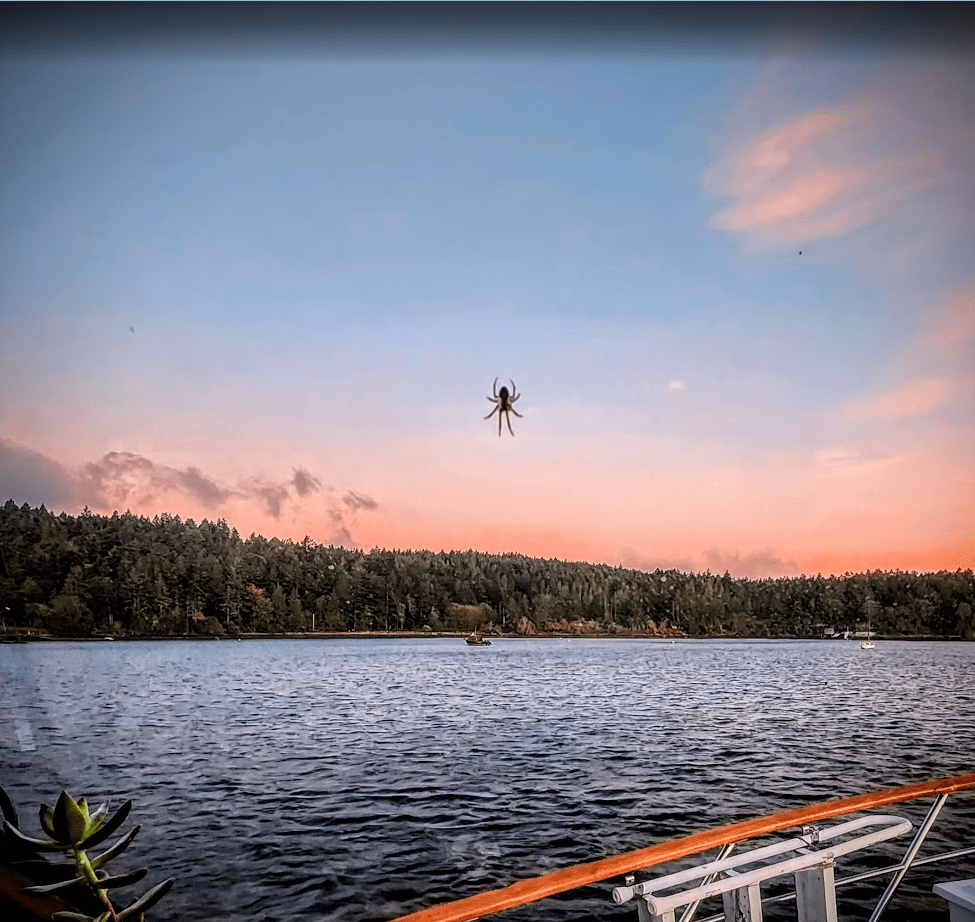
There she was. Bold as brass, commandeering our view out the pilothouse window. Oh she’s not really as big as the picture shows. I had to use a macro setting on my camera and the lens had to be about 3 inches from her. She was resting at the center of her extensive web and didn’t seem to mind the mountainous creature looming in front of her. We named her Charlotte, after the heroine of the children’s book: Charlottes Web.
We didn’t attempt to move her, and if you look carefully above her and on both sides, it becomes clear that she is doing us great favors by being there. There are several fruit flies tied up and waiting to be consumed. Yay Charlotte!
She was there for several days and… disappeared. I can only assume that tiny fruit flies are not a very highly packed source of energy that would meet the needs of a hungry spider. Most orb spiders do live outdoors. The pickings being better out there. I assume that is where she went.
Update: Les reports that she saw Charlotte just yesterday. She’s still lurking about… Good to know, eh?
So now you know…

 Salish Sea Cruising With Blair, Les, Leo, and Bliss