Our Cruising Platform: Great Northern, a DeFever 53 Performance Offshore Cruiser
The Mycoflora is Back. Shroom to me, Mushroom to Most, Fungi to Others. A Simple Fort Flagler Walk in the Woods
I have been playing around with this blog since early 2019. Most of the posts have to do with boating experiences. But… there are many other inclusions that include hiking, poetry, boat management, mechanical wizardry, repair, maintenance and observations. Reviewing posts I’ve written over the past four years, I find the content rather eclectic. One of my favorites is still the very first one: “The Beginning”. Here is a link that should take you to that content. It is a quick read. And the memories of that first cruise in Great Northern on the Columbia River is as fresh to me now as when I wrote it then. One of the main reasons I continue to add to the blog: The memories. Time dilutes them. Rereading them makes them fresh again. I hope you don’t mind my eclectic content… My first post:
And here is yet another posting about mushrooms. I’ve always been intrigued by them and fall hikes are filled with shroom discoveries…
10/1/24: Fort Flagler State Park. 5 mile hike. Shrooms discovered. They are now just about everywhere. Edibles. Poisonous for some. Not plants. Not animals. They’ve been around for a very long time and life would not be the same without them… Many species form symbiotic relationships with plant life and without that established relationship… neither species would survive. Nutrient sharing is a common thread.
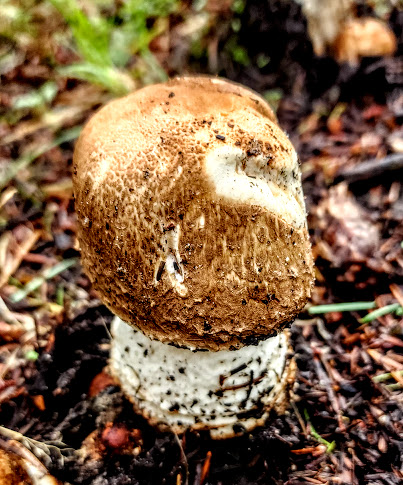
I’ll open with this: A bolete. Huh, wha… is a bolete. Well a young one looks like this:
Looka dat stipe (stem to youse)
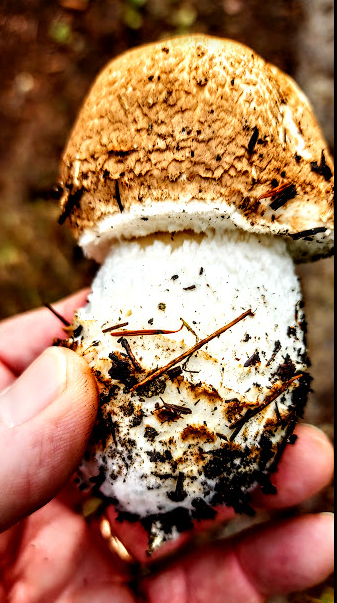
Besides having a mondo stipe, if you look closely between the cap and the stipe, you may note something else: It has no gills. Most boletes don’t. But of course… some do. They instead have really small pores. The pores are the ends of tubes. And… that is how the spores are cast: Down the tubes and out the pores. I think this example is a Leccinum sabrum (Brown Birch Bolete) Or… it might be a young Boletus edulus (Penny Bun Bolete), a choice edible. Or… perhaps a Boletus aereus (Bronze Bolete) Or something else… If it were older and more developed it might be easier to tell. I need to go back in a couple of days and take another picture if it is still there…
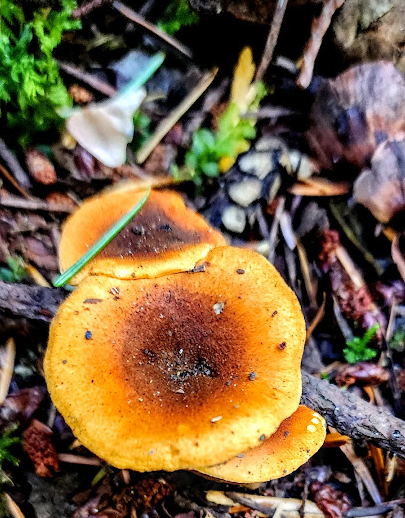
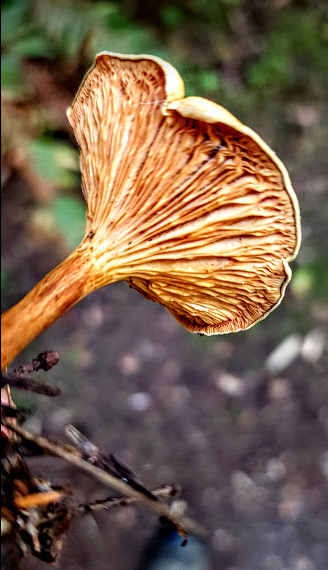
One might think that this could be an emerging baby Golden Chanterelle, a choice edible. But… looking at gills and stipe (stem to youse all) it might lead you in that direction. But there is more to it. See the next picture:
First off, the color is is more of a pumpkin color. Chanterelles are usually, but not always… more in the yellow tones and the stipes are smooth and white inside
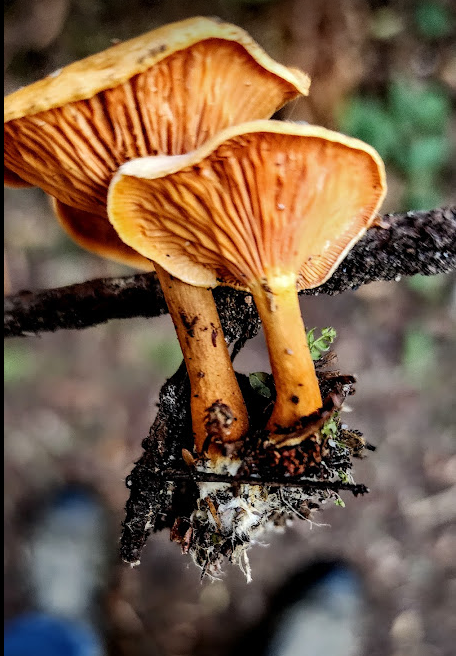
And the gills on this specimen continue on down the stipe
Which is clearer in this picture. Though I’m not certain, I think it is a Hygrophoropsis aurantiaca, a false chanterelle, and they are slightly poisonous. Note the “gill” structures continuing down the stipe in the false beastie. The color and stipe and inside orange color are descriptive clues. Whereas… the Cantharellus formosus (Pacific Golden Chanterelle is pale orange yellow, the stipe is smooth and the flesh is white inside. That’s why I never eat what I forage in the woods. It is hard to distinguish the difference between edible or poison…
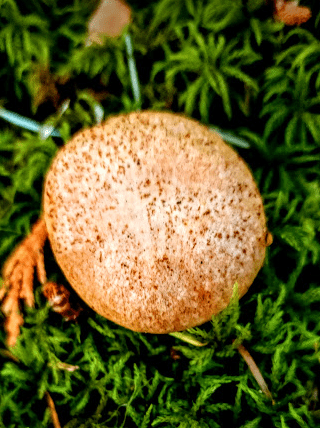
What might this be? Can’t tell at all by looking at the cap
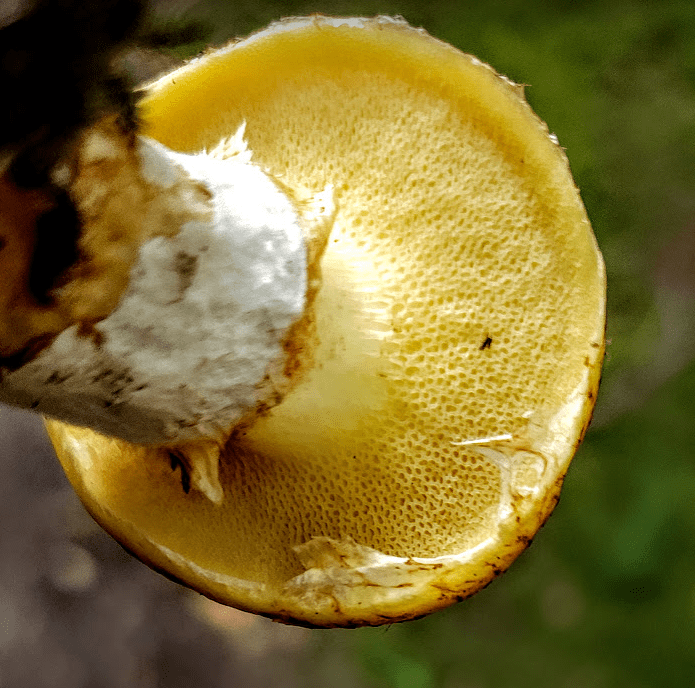
The best clue is on the underside of the cap. The pores suggest bolete of some kind, and the underside at this growth stage are light yellow. Hmmm…
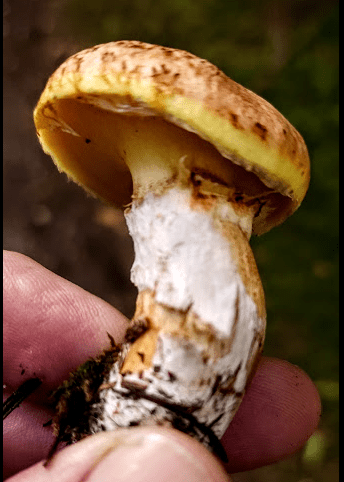
Stipe removed…
More clues. Whitish stipe with what appears to be the remnants of a “veil”, a temporary membrane that envelopes immature shrooms. The veil spots on the caps of the well known Aminita muscaria are veil remnants. So this has veil remnants and the stipe seems to be light yellow. Which might make it a Suillas lakei, or… uhh… who knows. Well many do know, but I’m not sure. But it is most likely a bolete
A Rusula Adusta, (Blackening Brittlegill or… since their odor when crushed is somewhat akin to an empty wine barrel, they are sometimes referred to as a Winecork Brittlegill.) This is a small one. Just now they are everywhere and are hard to miss. Quite a few of them can be found partially eaten. Deer and other foragers appear to like them. They emerge by pushing up through the detritus, thus their dirty presentation.
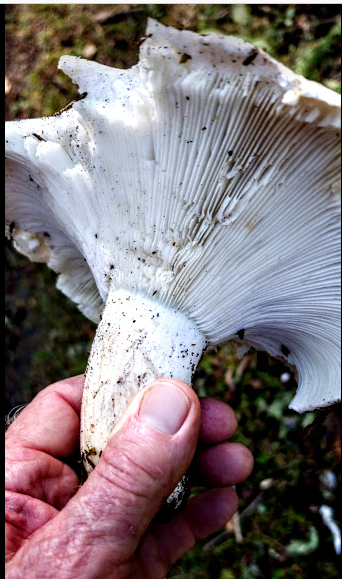
The gills… As you can see the gills are closely associated and… they are easy to break, thus… Brittlegill. Not particularly edible, but not poisonous. One would need to be hungry and there is a lot of dirt to remove and for the most part need to be cooked as should all wild shrooms.
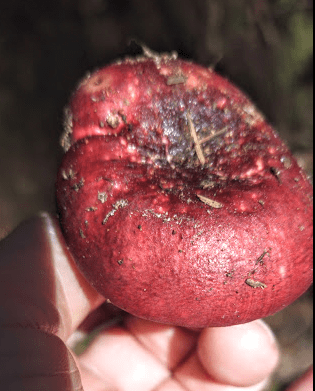
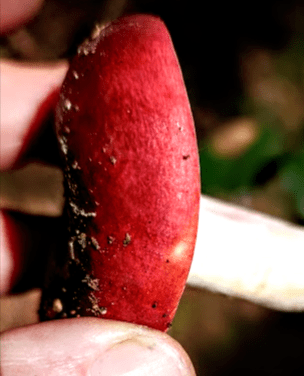
Hmmm… reddish cap
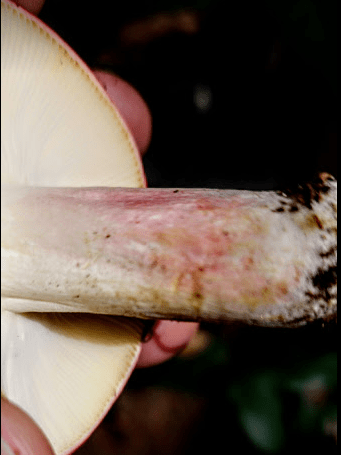
White, closely associated gills
Bit of pinkish coloration in the stipe. I’m thinking it is a Russula xerampelina (Crab Brittlegill), a choice edible. They were all over the place. Not so fast though… it could be a youngish Russula obscurozelleria, or a Russula vinosa, or a Russula rhodocephala, or… uhhh… hmmm… something else. It is most likely a Russula of some kind
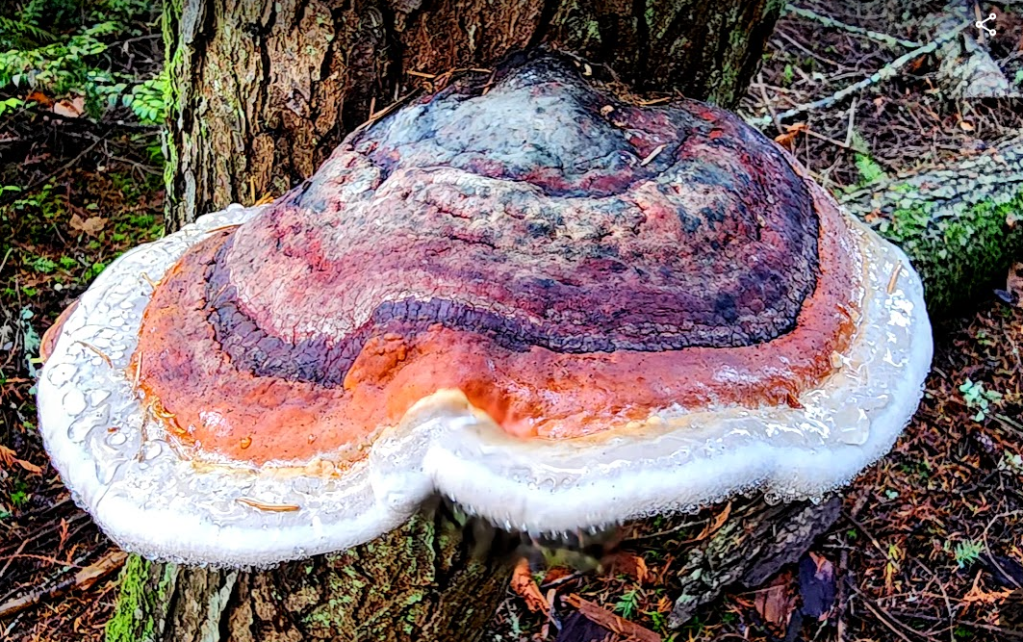
Mushroom of the day… a Polypore, Fomitopsis mounceae (red-belt conk), extremely common in conifer forests and a major player in recycling wood into soil. This one is large. They get larger…
And there you have it . This was a collection I found on 10/1/24. Once you get started looking you will find many different kinds, just sitting there, bold as brass doing their shroom thing. Hope you enjoyed this.
Les and I will be going out soon for more shoulder season cruising. Perhaps we will venture back into South Sound. As always… it will depend on weather, currents, tides and our fickle nature. We’ve got fuel, water, rations and desire.
Enjoy the fall… Summer has exited the stage, Fall is in center stage wrapped in her moss colored cloak and Winter is standing in the wings with his dark cloak draped across his shoulders, waiting for his cue to replace Fall.






 Salish Sea Cruising With Blair, Les, Leo, and Bliss