A high value marine electrician, Andy, finished an install of our new wired remote control for the engines, thrusters, engine stop buttons etc. on September 3rd. You might ask how he earned, in my estimation, his standing as a high value asset? To start with, he’s a graduate of the renowned Northwest School of Wooden Boat Building located in Port Hadlock, Washington. Secondly… he is a self-proclaimed electronics geek. That’s not my proclamation. It is his. When it comes to electronics and how they should be installed, the more complicated, the better. The electrical iterations on our thirty-eight year old Great Northern fit right into his electrical wheelhouse. Incorporating a wired remote into the electronic controls for the engines, transmissions and thrusters fit right in with his project style. It required many circuits to be interrupted and incorporated into the electronic pathways of the remote. To boot, the available instructions that came with the device were… more like stick figures than a fully drawn electrical diagram.
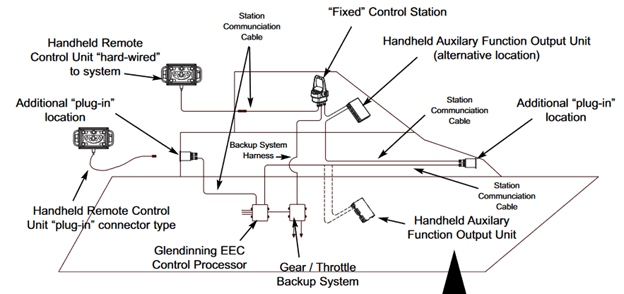
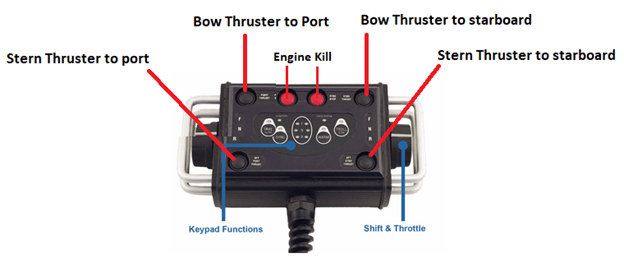
A secondary measure that adds to his “high value” moniker: He discounted his fee for the installation. He claimed that due to very recent bike related injuries, he was moving much slower than usual. I’ve never had an electrician do that before. So, high value points for skill set, problem solving ability, and additional points for integrity. “High value” on every level.
You see… Andy would have performed his magic sooner so we could leave on our semi-planned shoulder season cruise. Unfortunately… a couple of days before the project start date, he was out riding his mountain bike and hit a hole someone had dug right in the trail. Trapped by the hole, his bike stopped, brick wall style, and his momentum forced an unceremonious flip over the handlebars. He landed on his shoulder. Better than his head of course, but the shoulder was wrenched into a position that it was not accustomed to, nor happy with. Associated bones, ligaments, tendons and muscles were no doubt, experiencing separation anxiety. Their displeasure with the rearrangement offered up significant swelling and pain. The usual. Of course… that is their job when tweaked: Slow the human down so the tweaked structures can heal. Anyway… the resultant injuries made it very difficult for him to crawl into the compartment in the pilothouse that contains most of the boat wiring. And… that was where 95.632% of the install needed to occur. Hmmm… a one armed sapien in pain, attempting to crawl like a worm into a tight spot with decorum… Bottom line: It slowed him down. Doing what he could do and employing intermittent rest, OTC meds and cryotherapy… he got it done, AND discounted his fee accordingly.
We thoroughly tested our new semi-robotic friend: Leave the dock, rotate 360 degrees (essentially a pirouette), and return to the dock. Now riding a dressage horse and perfecting a trot pirouette, or better yet… perfecting a canter pirouette on a 1500 pound warmblood is something to experience. Performing a pirouette on a 75,000 pound boat is… well… substantial as well. We pushed all the buttons and twisted the throttle controls with wild abandon… Wash. Repeat. And… everything works! It’s magical. In the old days, the captain (me) was stuck in the pilothouse operating our 75,000 pound machine like the Wizard of Oz behind his curtain, reliant upon a bungling wifi camera that gave me a vapid facsimile of how far or close a dock was to Great Northern. It seemed to have a penchant for failure when piloting through any maneuver requiring intricate visual calculation. I don’t know why. I tried to be nice to it. Charging when necessary, feeding it data through several different routers etc. All that aside, the best part: I am no longer dependent upon its feeble attempt to be my eyes. I can use my own eyes directly, without that flawed human to camera interface. The remote control has replaced it. I would go so far as to call it a game changing disruptive technology.
Plug it in. Open the pilothouse side door. Walk out. Casually lean over the rail and take a gander about where the boat actually is and what needs to be done to safely get it to a dock to tie off, or carefully maneuver away from a dock. Rotate the starboard engine control forward, and the Port engine control back… and Great Northern performs an elegant pirouette. Not enough? Press the buttons for the fore and aft thrusters and she sashays left or right with dignity, purpose, and tenacity.
There is nothing quite like having eyeballs on a target. Cameras do not provide enough feedback to cozy a 75,000 pound boat up to a hard object like a dock. For the most part, eyeballs do.
Our shoulder cruise so far:
9/6/24: Port Ludlow to Hunter Bay on Lopez Sound, a 40 nautical mile passage. Mechanically… it was an uneventful passage. As I’ve noted in past blogs. Uneventful is a good thing. All the mechanical data we collect on an hourly basis during a passage:
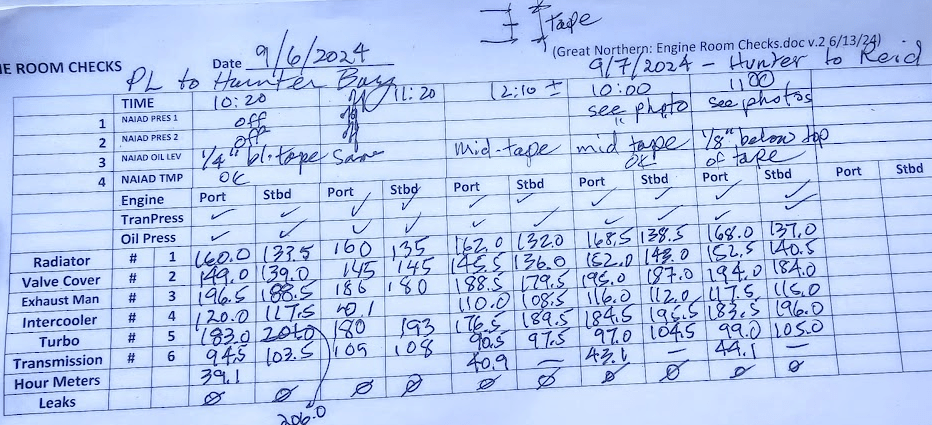
A bit compulsive you say? Could be. Then again. It is the responsibility of the Captain and Admiral to get from departure to arrival safely and efficiently. Serially documenting engine temperature temps can show meaningful trends that might point out impending issues that an engine water temperature gauge won’t. Example: A 10:20 starboard engine turbo temp of 201 degrees is clearly out of the ordinary, but certainly within the range of temperatures that turbos are exposed to. Explanation: That temp occurred when I bumped the throttles to get through the shipping lanes in Admiralty Inlet. A 950 foot container ship traveling at 19 knots in Admiralty Inlet pointed in our direction. It was in the shipping lane. We were crossing the lanes. The GPS and AIS systems calculated that our closest point of approach (CPA) was reasonable, but bumping the throttles up a bit brought us to a steady11.5 knots. I maintained that speed until the CPA reported on the chart plotter started to increase. It was a 4 or 5 minute spurt. This explains the increased heat in the turbos. The port engine (Fred) is always a tad higher that the starboard engine (George) because the port engine also runs the pump that provides hydraulic pressure the the NAIAD stabilizer system. A discussion with a mechanic is warranted, but… I suspect it isn’t a problem… That being said, I do have the data for a mechanic to review. And, we have years of data. The other important pieces of the hourly checks will expose: Fluid leaks, fraying belts, transmission pressures, etc… all things that need to be addressed before somthing bad (and expensive) occurs. By the way, just soze ya noze, the Admiral (Les) performs 90% of the engine room checks.
The rest of the 40 nautical mile passage story: Very little wind. Glassy water for the most part. No swell. No fog. Mostly sunny. Perfect September marine weather. No problems with commercial traffic at the usual spots. The NAIAD stabilizers did not leak any bodily fluids, and worked perfectly the few times we felt they were needed. Our navigational route planning and passage timing made the best use of currents. Our base speed was 8.5 knots through the water (STW) at 1600 RPM. The following are speed over ground (SOG) notations: 11.3 knots through the Port Townsend Canal. 10 knots through Townsend Bay, 10-11.5 knots when I bumped the throttles to cross Admiralty Inlet through the shipping lanes. Then back to 1600 rpms and saw: 9-10.5 knots between Partridge Point and past Smith Island. We slowed down to 7.5 knots as the last of the ebb flowed out of Rosario Strait. I expected that, and to attenuate a bit of the “headwind current” I’d altered our route to stay close to the East shore of Lopez Island where the current was less. As soon as we got close to the shoreline of Lopez we were back to 8.5-9 knots from the Southern end of Lopez Island to Lopez Pass. In the pass we accelerated up to 10.5 knots and carried that through the Pass. As we entered Lopez Sound we were back to 8.5 knots. And… the second time I touched the throttles during the passage, I pulled them back so we could enter the anchorage at Hunter Bay at 4 knots. Voila!
Bottom line: Currents can be your friend if you know how to ride them. Opportunities abound for that while cruising the Salish Sea.
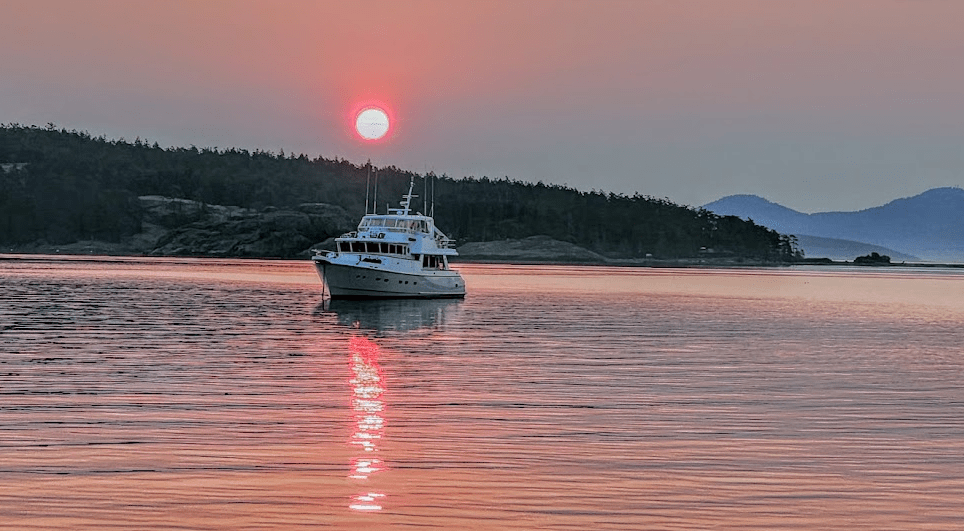
Hunter Bay as our usual first destination when motoring to the North from Port Ludlow. It is a mere 5 hour cruise from Port Ludlow, and a wonderful anchorage. It’s not the best place to be in strong Northerlies, but it is seldom crowded. It meets all the desired check list items of our Hudson Bay Rule. Anacortes is only 12 nautical miles away where fuel, chandlery, marine technicians, divers etc. are available. So, if something goes awry or we forgot to bring something along… it will be available there. And… it has sunsets and sunrises covered:
9/7/24, 0700. Hunter Bay. Breakfast: Huevos Rancheros. Spicy beans laced with garlic, chili chipotle, shredded cotija cheese, carmelized onion, and ground cumin. Scrambled eggs laced with a bit of garlic and black pepper topping the bean concoction. Another dash of cotija, followed by ranchero sauce and some hot sauce. We have this smokey, black, chile habanero sauce made by El Yucateco, that is the perfect final topping that turns the regular into amazing huevos rancheros. A warm tortilla is served on the side to nibble on. Oh my! Time to do the dishes and then hoist the anchor.
0830, morning passage: Hunter Bay to Reid Harbor, 21.5 nautical miles, a 3 hour cruise. Start at 08:40. Arrival: 11:30. For us, another picture perfect passage. Relaxation was in order for the rest of the day.
9/8/24, 07:20: Sunrise, Reid Harbor, Stuart Island
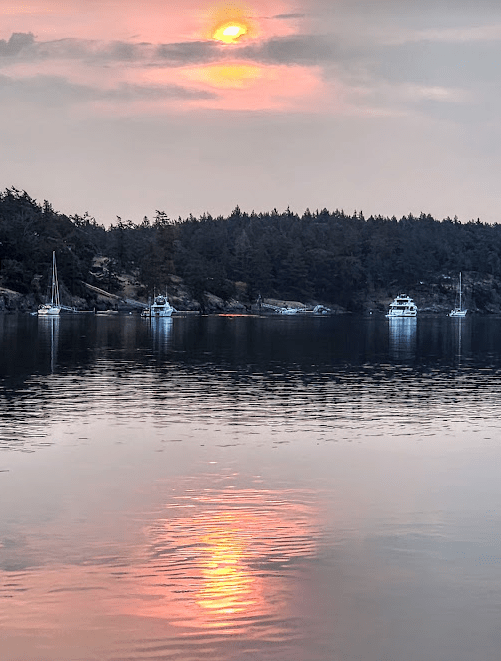
Breakfast: Rice and eggs. Mid-morning hike: State Park dock to the grass landing “airport” and back. About 3 miles. We cut the hike short so Les could break in / assess her new Salomon Quest hiking boots. Her last pair was a size 7.5 and started to cause some damage to her big toes after hiking about 1000 miles in them. So… after 11 months and 1000 miles of root filled, rocky trails we returned them to REI for a full refund. REI may be expensive, but their return policy is phenomenal. Her new boots, the same design, are a size 8.5, and are working out swimmingly. After a 15 miles of hiking, all is well with her toes and feet.
Linner (lunch/dinner)15:00: Beet and Pear salad with pine nuts and chopped romaine. Dressing: balsamic vinaigrette. Boxed cab. Nighthawk Bourbon Barrel, cabernet sauvignon, our house wine, brought to us by Bota Box. Why knot?
Sunset, 20:11. Nap time shortly thereafter.
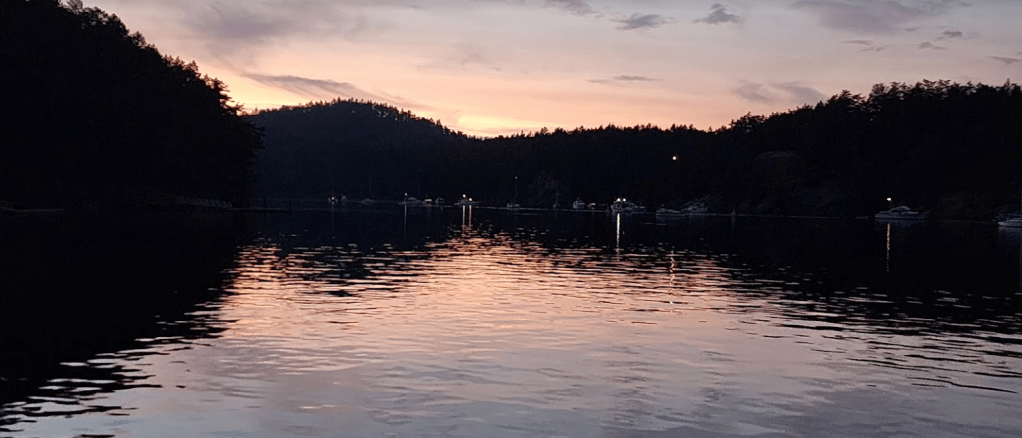
9/9/24 Breakfast: Steel cut oatmeal with strawberries, blueberries, blackberries and pine nuts with a bit of brown sugar. Elegantly simple fare, eh?
Bolstered with calories and coffee, and taking advantage of stellar fall weather, we went on a hike: State Park dock to the Turn Point Lighthouse and back: 6+ miles. Up / down trail with rocks and roots with gravelly roads in between. It is one of our San Juan favorites: Our route takes us through the park to its Western boarder. An interesting side trail in the park led to:
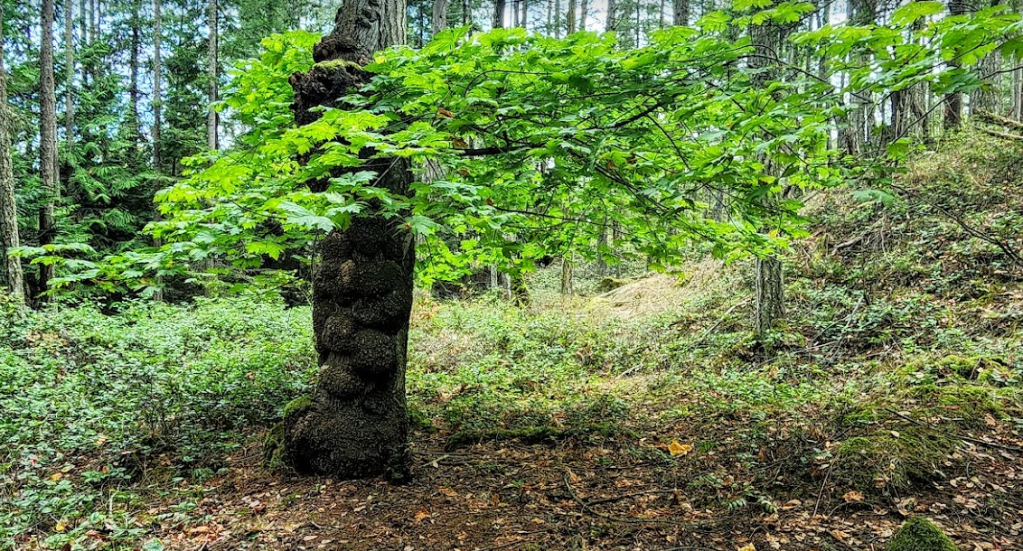
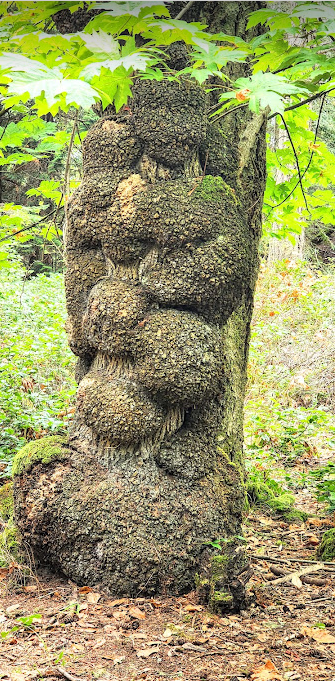
Next tourist attraction: The one room Stuart Island “school house”. It is the first time in several years that it is now in session. It only opens when there are enough kids on the island to warrant bringing in a teacher. No additional pictures. They are in a previous blog… (https://wordpress.com/post/boatingongreatnorthern.org/4626) But, next to the school in the woods is the world famous Stuart Island t-shirt treasure chest in full operational mode:

An enterprising couple operates and maintains the “showroom”. Proceeds from the sales helps them to live year around on the island. We have purchased many of their shirts. Solidarity with entrepreneurs! For more information about the Boundary Pass Traders: https://www.boundarypasstraders.com/
Next: Yaks in the distance on the Eriksen farm. I didn’t take a picture. They were too far away… We were just glad to see them. (See URL above for Yak pictures)
Just up the gravel road: A colony of ant people:



Lunch at the Turn Point Lighthouse: 1/2 of a chocolate / brownie cliff bar, a handful of peanuts, and slurps of water. (Gourmet hiking food)
Dinner: 15 bean soup with chorizo in a beef broth, chopped, caramelized white onion, garlic, fresh corn on the cob shaved from the cob and added to the soup. It is always topped with Mexican style sour creme and shredded Asiago or Pecorino Romano cheese. Yum. Just because we are in the whoop whoops doesn’t mean we have to eat top ramen.
While prepping dinner we had the gen set running to get the battery bank up to snuff. To give the generator a bit more to do, we did a load of laundry… because we can. Cruising in a powerboat makes such things possible.
That’s it for now folks… Tomorrow… who knows: Off to Canada, or remain in the San Juan Islands for a bit longer. We’ll see when the weather, currents, winds appropriately align to suggest our next destination.
So that describes a few of our days in the beginning of our shoulder cruise. No flashy locations. Trafalgar square was so last year. Odessa and Yalta a distant memory. Avalon, a thing of the past. We now have mountains, majestic forests, the magnificence of the Salish Sea, hiking, wildlife, and oh yes: whales.
Next up: Magic at the Turn Point Lighthouse…
Admiral…Thar Be WHALES here!

 Salish Sea Cruising With Blair, Les, Leo, and Bliss
Hi Blair! I really do enjoy your blog stories. I’m waiting for a novel in the near future! (But I have to admit you lose me when you delve into the electronic world lol) The beauty of the pictures you post are breathtaking. I don’t know if anyone told you that Connie Estes passed away a few weeks ago. There will be a remembrance for her this Saturday. A sad couple of years between stomach cancer, 2 surgeries, a colostomy, and a fall where she broke the top of her femur and had a 3rd surgery. She ate very little and really lost her will to live. Rick and I were at her home almost every day to help with one thing or another. Sad story. On a brighter note Rick and I leave for Kauai on Sept 21st for 2 weeks. Looking forward to it Miss you frabl. Love and hugs ❤️😊Level
Yahoo Mail: Search, Organize, Conquer
LikeLike